


How long have you had Rabarbergaarden?
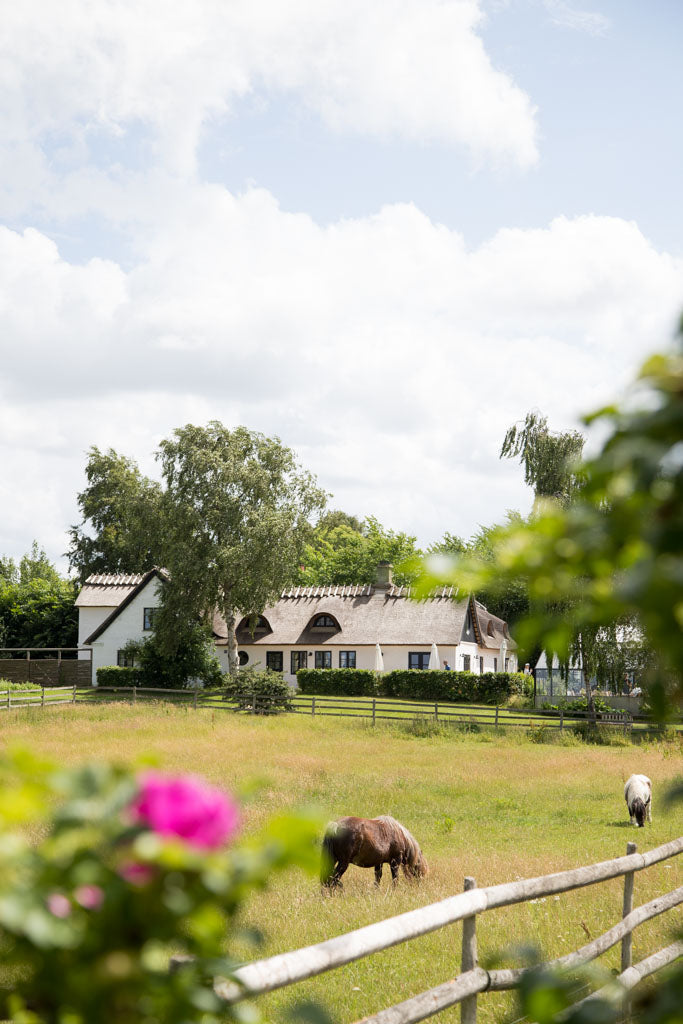
My wife and I bought the farm 18 years ago to get out of Copenhagen. At the time we lived on Elmegade, but decided we would like to move to the countryside. Already at that time, we actually had a summer delicatessen shop in Tisvildeleje. And then we came across this farm that looked like a ruin. My wife could definitely see the potential. I couldn’t see that at all. But we threw ourselves into it, and in the first eight years we lived here, while we both worked in Copenhagen.
What changed?
The more we lived here, the more we began to think about whether the farm could one day be a workplace for us. I’m a trained chef, and my wife works with film and media, so neither of us have an agricultural background. However, at that time there was one of our good friends, Søren Ejlersen, who had started the project called “Gardens for Bellies”. He asked if I wanted to join in and help spread the word. “Gardens for Bellies” is a school project in collaboration with the local municipality, which is about bringing education and teaching out into the open, where students learn about food- and nature science along with agriculture. So when it got started, all of a sudden there was a small business that started on the farm. We made a small profit, and we were able to hire a gardener, and I started teaching at “Gardens for Bellies”, so that I didn’t have to work in Copenhagen full-time. At that time, a process started for Louise and I, where we began to think that it would actually be quite exciting to investigate how we as a family can survive on four hectares, while at the same time creating job opportunities locally. It was at that point in time, when we simply said to ourselves let’s renovate the farm, and then we’re doing something that abroad is known as a farm restaurant. So we closed everything we had in Tisvildeleje, rebuilt the farm, and then we opened as Rabarbergården’s farm restaurant and grocery store. And it’s been about eight years since then.
So the restaurant is located where you originally lived?
Yes, the restaurant is in our old living room. And where you walk in [the store], that’s our old teen section for our two kids. So in that way we created a restaurant on the farm. The idea was of course that we would become really good at staying self-sufficient. However, we also found out that unfortunately we have the worst soil to grow vegetables in. It’s not a nice thing to learn. And that’s just something you cannot expect to know when you’re not a trained farmer. I think if I had been a farmer when we bought the farm 18 years ago, I probably would have started by digging a hole in the ground and find out what kind of soil it really was. Instead of just looking at the buildings and thinking it looks romantic. But we didn’t do that, because we didn’t have that knowledge. We first found out when we had to grow for the restaurant the first year, where the top of the carrots grew a meter high. I walked around, dreaming that if they are a meter high, they are probably also a meter down in the ground. But they were just about a centimeter and a half.
What did you do then?
We learned a lot the first year, and in collaboration with our gardener we learned that we had to find another way to grow. So we started growing in a way called “market garden”. Here you add compost to your soil, so you actually end up — after a few years — with a really big layer of soil on top of the regular soil you have. We add around 10 tons of compost to our beds every year. This means that now, after 8 years, we are simply growing the most fantastic vegetables. The carrots are long, the parsnips are long and crisp and juicy.
It says on your website that you are Denmark's first farm restaurant. How is that so?
I don’t think at any point in Denmark the term farm restaurant has been defined, even though it is big in the US and France — and especially in England, where we have traveled a lot. In the first few years, we spent a lot of time explaining what we are. In other words, we are not the traditional, organic farm shop where you go and get a coffee for 1.50 € and a cheese sandwich for 2.50 €. We are something else. We are a high-end restaurant. We have the same prices as any good restaurant in Copenhagen where you go to get a four- or six courses menu. So we have struggled a bit with the word. Should you Americanize it and call it a farm restaurant? Do people get it? Or should we try to tell about the fact that there is something new in Denmark called a farm restaurant? And fortunately, more have subsequently been added. But I think that eight years ago, when we opened here as a restaurant, not many people knew what a farm restaurant was. So this thing, about us being the first, we probably are in the way we decided we would do it. But I know that there are more people who share the same thoughts and ideals, who believe that people crave that experience and to know where all the ingredients actually come from.


